5 Effective Steps to Master SHRM CP Situational Questions
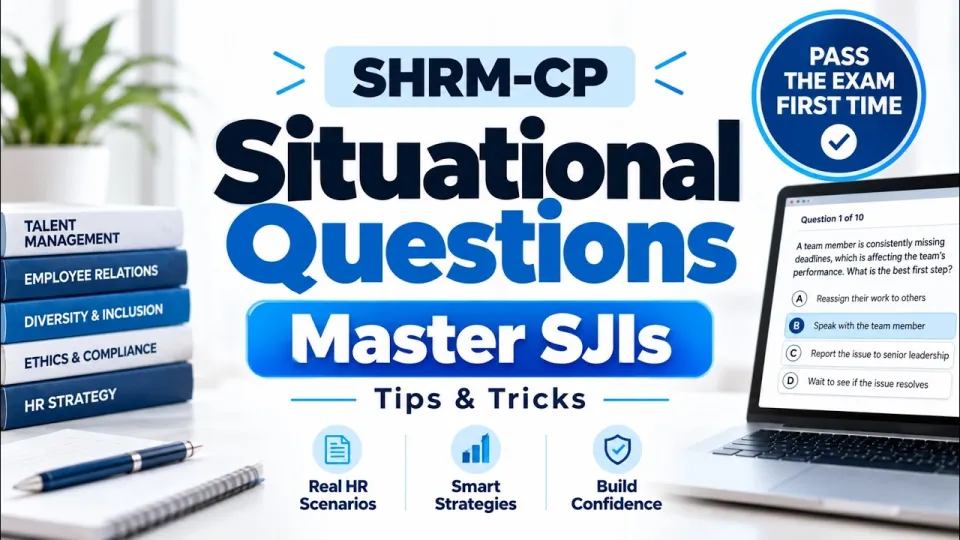
Video: SHRM CP Situational Questions (SJIs) | TIPS TO PICK THE RIGHT ANSWER
· based on the channel PrepSolution
Key takeaways
- SHRM CP situational questions test judgment in HR scenarios
- Five decision checks help select the best answer
- Recognize five common answer traps to avoid mistakes
- Distinguish between first step and most effective action
- Practice with real workplace scenarios to improve accuracy
SHRM CP Situational Questions can be challenging because multiple answers may seem correct. To master these situational judgment items (SJIs), it’s essential to apply a structured approach that considers HR policies, legal compliance, escalation protocols, and stakeholder involvement. Using this method, you can confidently select the best response rather than just a reasonable one. For practical practice and free resources, visit PrepSolution's free SHRM-CP practice questions.
Understand the Difference Between First Step and Most Effective Action
Many SHRM CP situational questions require you to identify either the next immediate step or the best overall solution. Clarifying this is crucial:
- First step questions focus on the immediate action to move the situation forward correctly.
- Most effective action questions ask for the option that addresses the problem comprehensively and sustainably.
Misinterpreting this can lead to selecting answers that are either premature or incomplete.
Apply the Five Decision Checks for HR Scenarios
When evaluating answers, use these five decision checks:
- Facts: Does the option align with the given information?
- Policy and Law: Is the action compliant with company policy and legal requirements?
- Appropriate Escalation: Is the problem escalated correctly and only when necessary?
- HR Role: Does the answer respect HR’s responsibilities without overstepping?
- Stakeholders: Are all relevant parties properly involved or informed?
This framework helps differentiate between seemingly correct answers and the best choice.
Recognize and Avoid Five Common Answer Traps
SHRM CP situational questions often include distractors designed to test your judgment. Watch out for these traps:
- Premature Action: Acting too quickly without sufficient information.
- Passive Responses: Avoiding necessary intervention or deferring action excessively.
- Taking Over Manager’s Responsibilities: HR should support, not replace, line management.
- Unnecessary Escalation: Escalating issues that can be resolved at the appropriate level.
- Legally Defective Options: Choosing answers that might expose the organization to legal risk.
Identifying these traps helps eliminate incorrect answers systematically.
Use Practical Elimination Techniques Based on Scenario Details
Relying solely on your own workplace experience can mislead you because SHRM questions are standardized and scenario-based. Instead:
- Test each answer against the question’s exact facts and wording.
- Consider the context and what the scenario explicitly states or implies.
- Discard answers that conflict with stated policies, laws, or the HR role.
This analytical approach narrows down choices effectively.
Practice with Realistic Workplace Scenarios and Reflect on Your Choices
Working through detailed HR scenarios, such as a supervisor requesting disciplinary action after a shouting match, sharpens your skills. For example, deciding how HR should respond involves weighing escalation, policy application, and communication carefully. Pause, pick your answer, then review detailed explanations to understand why one option is superior.
Engage with practice questions regularly to improve your ability to spot traps and select the best response consistently.
Useful Links
Summary
Mastering SHRM CP situational questions involves understanding whether the question asks for the first step or most effective action, applying five key decision checks, recognizing common answer traps, and using elimination strategies based on scenario facts. Practicing with realistic HR cases enhances your judgment. The PrepSolution channel offers detailed explanations and tips that can clarify why one answer fits better than others. Use their free practice questions to sharpen your skills and boost your exam confidence.
Source: SHRM CP Situational Questions (SJIs) | TIPS TO PICK THE RIGHT ANSWER · Markdown version
Questions & answers
What are SHRM CP situational judgment questions?
They are exam questions designed to assess your ability to make effective HR decisions in workplace scenarios by choosing the best response among several options.
How can I tell if a SHRM CP situational question asks for the next step or the most effective action?
Carefully read the question wording; it may specify 'next step' or 'best approach.' Understanding this distinction helps select an answer fitting the sequence or overall solution.
What are common traps to watch for in SHRM CP situational questions?
Common traps include premature actions, passive responses, taking over a manager’s role, unnecessary escalation, and selecting legally risky options.
Where can I practice SHRM CP situational questions with explanations?
PrepSolution offers free SHRM CP practice questions with detailed answer explanations at https://prepsolution.com/free-practice/shrm-cp?utm_source=youtube&utm_medium=video&utm_campaign=shrmcp_longform&utm_content=cp_long_v09.